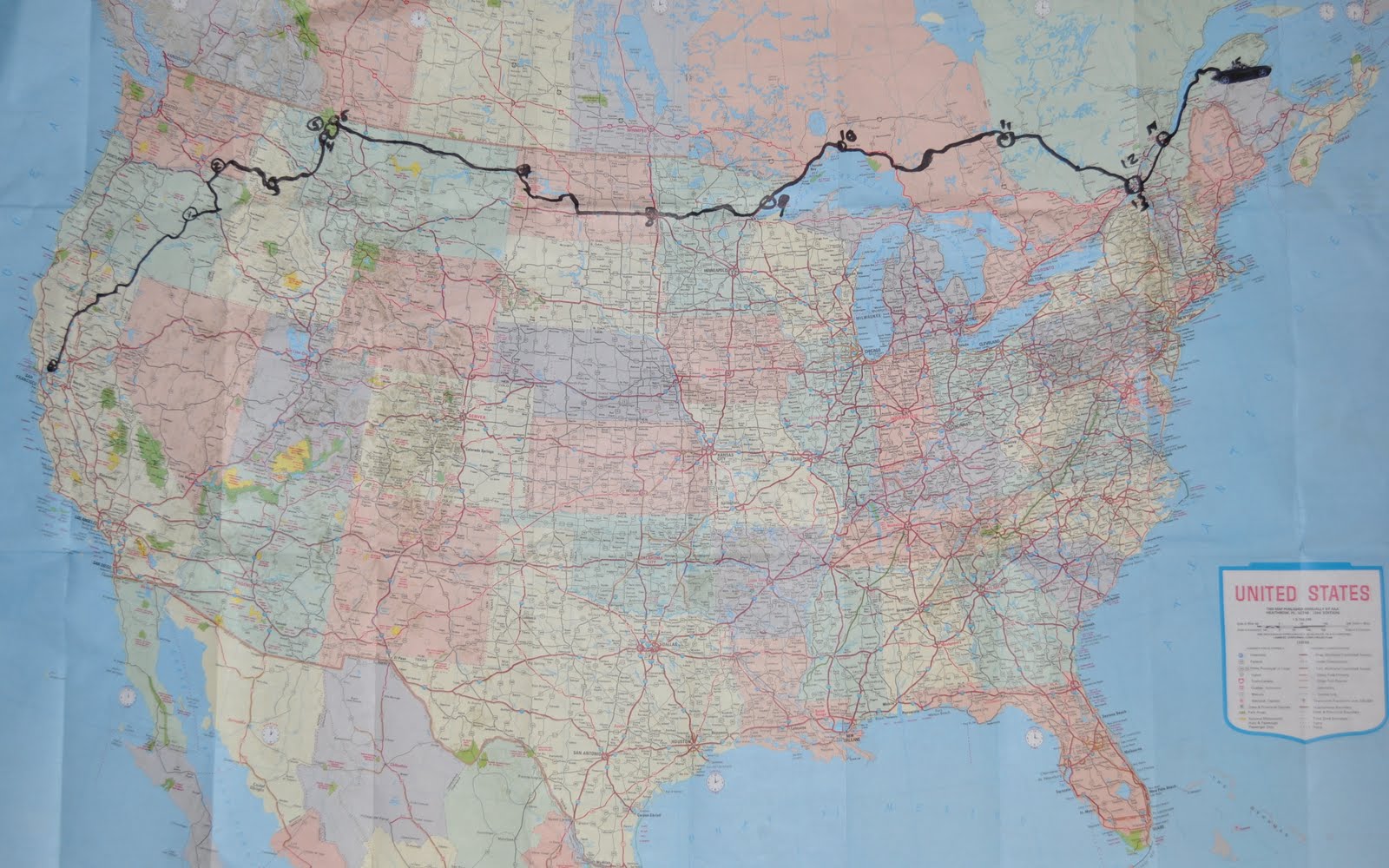
Friday, June 25, 2010

Day 17: Parlee Beach to the Newfoundland Ferry

Day 17


Miles 444 (5402)
Two Lanes 270 (4362) 81%
Top Down 444 (4978) 92%


Leaving beautiful Parlee Beach, we drove into Nova Scotia, and across the causeway onto Cape Breton Island. The southwest coast was settled by Irish immigrants whose descendants still speak Gaelic. This was a new kind of bilingual for our trip: many of the signs were in Gaelic and English. We stopped at a bakery and bought some bread and rolls just out of the oven.

Next Stop: Glenora Distillery. This is the only maker of single malt scotch in North America. We tasted (of course) then bought a bottle of the 15 year (don’t ask how much!).

Then onto the real treat for the day: The Cabot Trail around the tip of he island. Listed as one of the world’s great drives, we decided to take the extra 140 miles because it was a beautiful sunny day. The pictures tell the story.

We arrived at the ferry terminal for the 15 hour sail across 256 miles to Argentia, Newfoundland. W e would arrive at 1 pm tomorrow. Fortunately we had a stateroom. It was Spartan, but it was a bed! Too old to sleep in the seats.


At Glenora on Cape Breton Island: the only maker of single malt scotch in North America.


Driving the Cabot Trail around the tip of Cape Breton in Nova Scotia


Waiting our turn to board the MV Smallwood


A load bound for Newfoundland


Driving into the bow


Linda doing her daily drawing


Leaving the port of North Sydney

Day 16: Dalhousie NB to Parlee Beach NB

Day 16 June 22 Our 36th Anniversary!

Miles 271 (4958)
Two Lanes 251 (4092) 83%
Top Down 271 (4534) 91%


We had breakfast and drove into Acadia. What is Acadia? Well, it is not really a place, but a people and a culture. The Acadians were French Catholic immigrants, many from Brittany on the Bay of Biscay in France. Thy came as all settlers did, to find a better life in the 16th-18th centuries. They were and are a peaceful, community-oriented people whose historical calling was the sea. They are fisherman.

The Acadians settled along the coastlines from northern Maine, along New Brunswick, Nova Scotia, Newfoundland, and the southern face of the Gaspe Peninsula of Quebec.

The Lands of Acadia don’t fit neatly into current geopolitical boundaries. But they have a flag that many fly on poles from their homes: the French flag with a large gold star in the upper left corner.

The story of the Acadians is bitter sweet. Made famous by Longfellow in his 19th century classic “Evangeline”, they were persecuted by the British in 1755 and forced to swear allegiance to the British Crown or be forcibly deported, often with little concern for keeping families together.

France and England had fought for years on and off in the New and Old Worlds. They were archenemies. Following the end of the wars of the 17th century, the Treaty of Utrecht was signed in 1703. This treaty transferred ownership of the lands of New Brunswick and Nova Scotia to the British from the French. The Acadians were affected deeply by this transfer by an agreement made thousands of miles away about issues which they had no involvement.

Nevertheless, the British ignored Acadia for the next two generations. But in 1755, things were again heating up with the French, this time in the New World. On the verge of the war of 1756-1763 (The French Canadians and Acadians call it the War of Conquest; the British call it the Seven Years War; and the Americans know it as the French and Indian War), in the summer of 1755, the British required all French speakers (Francophones) to swear an allegiance to the crown of England.

The Acadians were peace loving, and without care to the larger world politics. They did not even know or care who the King of England was. Many did not take the oath. Of the 14,000 Acadians, 6,000 were forcibly deported. Separated to places around the globe, many were sent to French Louisiana, the ancestors of today’s Cajuns.

But many fled or hid. The forests are quick thick and the Acadians had long ago befriended the local natives, the Mic-Maqs. Many lived for years in the woods.

After the British defeated the French in 1763, the Acadians were no longer seen as a threat, and slowly they returned.

There are many tragedies of this story. Evangeline, and all those she represented, was separated from her lover, only to be found by him in Louisiana by him years later after she had died. The other tragedy is that human kind continues to behave this way. Go to Manzanar on the east slopes of the Sierras and experience how we treated first, second or third Japanese American citizens during a state of fear. Or read Snow Falling on Cedars.

Or think about our own (some would say “understandable”) paranoia after 9/11 and how many called for limiting freedoms of Muslims.

So what is the sweet side of the bittersweet Acadian story? They have returned, survived, and prospered. They are a very proud people. First Acadian, then Canadian.

At dinner this evening we were served by Dominique LeBlanc, a young Acadian in her early twenties completing her college degree. She told us the story of her family. She is ¼ Acadian, ¼ Norwegian, ¼ Scottish and ¼ Irish. But she is Acadian and proud of it. Her father’s ancestors hid with the MicMaqs in 1755. The story is told over and over each generation. This story survival amid persecution was her bedtime story, over and over. She will tell her children. The oral history, its strength, and its perseverance are an inspiration for all of us. And it is a story of non-violence.

Today, New Brunswick is he only political unit on the world where by constitutional law all printing of signs, menus, etc must be in French and English.

But Dominique warned that they still must be vigilant, and then are constants attempts to weaken this. The main tool that the Acadians have in New Brunswick is economic. 40% of all New Brunswickers are Acadian. As tight a group as they are, any economic boycott of businesses with unfriendly practices could be catastrophic to those businesses.


Back to our travels.

To learn more, we visited Les Villages Acadien near Caraquet, New Brunswick. This I a collection of homes and buildings moved from around New Brunswick to give the visitor a taste of Acadian Life in the 18th, 19th and early 20th centuries.

Then to the Miramichi River Valley, the #1 place for Atlantic salmon fly-fishing in the New World. Someday John Hurlburt and I will return here to catch our trophies

Then on to our destination for the night: Parlee Beach. This is the “Florida” of Canada. Here on the northern shores of New Brunswick is the Northumberland Strait. Shallow waters, protected by Prince Edward Island, Newfoundland and Nova Scotia. It is the warmest water north of the Carolinas.

We tested that. At 7 pm the air tempo was 78, the water temp as about 76, and the beach was full with many in the water!

Then to the wharf to the Sand Bar where Dominique served Linda a one-pound lobster caught that day, and I had outstanding fish and chips (fresh Newfoundland haddock).


The Flag of Acadia


Invited to lunch


Scene from Les Villages Acadien


The wide and shallow Miramichi River


Parlee Beach at 8 PM !!


Thursday, June 24, 2010

Day 15 Quebec to Dalhousie, New Brunswick

Day 15


Miles 343 (4687)
Two lanes 240 (3841) 82%
Top Down 343 (4263) 91%


We departed the walled city of Quebec by driving through the gates of he city, then across the St. Lawrence and down the fertile river valley. We had purchased a landscape etching in Quebec of the farms along the river with the island of Grosse Isle in the background. We drove to the approximate spot where this was done and took photos.

Gross Isle is very important is Canadian history. All travelers in the late 19th century who arrived by ship up the St. Lawrence were quarantined here and prepared for immigration. It was the Ellis Island (NY) or Angel Island (SF) of Canada.

Driving further down the broad valley we pulled off the road about 5 km, our eye caught by the sign for the “Cidererie”, the apple cider maker. We drove up and the sign said “Ouvert”. We are now deep into French speaking Quebec where they know about as much English as I know French. The door was locked. There was a phone number on the door to call to have it opened. Just as we were debating whether to call o not, Gilles (the farmer, cider maker, owner) drove up from the fields in his tractor, saw us, and pulled over. He greeted us and we entered.

Hard cider. Good stuff. More like a very dry apple wine. Alcohol 11%. It was very good, and not sweet. He also had hard apple champagne. We bought one of each.

Then on down the valley to stop at the Basque fromagerie. Ummmm. Fresh cheese, some it being made before our eyes. Of course, more purchases were made, and the apple wine, the cheese, along with the bread and summer sausage we bought in Ontario….became lunch.

Then on to Les Jardins des Grand Metis. The Reford Gardens. Mr. Reford was a high level executive in the Canadian Pacific Railroad in the 19th century. His summer home was in the lower St. Lawrence Valley. When he died, he left it to his niece, who spent 32 years developing these amazing gardens, all of which freeze and are covered by snow in the winter!
We are about two hours from our hotel and we need dinner, The evening is glorious. Warm and sunny. We traverse the Gaspe Peninsula and head down the valley of the Matapedia River. This river is on of the great salmon fly-fishing rivers of the world. We stopped at a market but they were out of fresh salmon, so we bought fresh Dover sole. 4 dollars for two large pieces. We stopped at a roadside rest near an old covered bridge, where the fishermen were wading at dusk in the shallow gravel bottomed river.

We broke out the BBQ from the truck, and cooked the sole. Delicious.

Tomorrow night though, it will be lobster.

Yum...Hard Cider


Gilles and Steve


The Classic French Catholic Acadian church with the silver spire.


Reford Gardens


Monday, June 21, 2010

Day 14: Montreal to Quebec

Day 14

Miles 156 (4344)
Two Lanes 0 (3601)
Top down 156 (3920)


Yes we were bad. Freeway all the way, but the top was down!

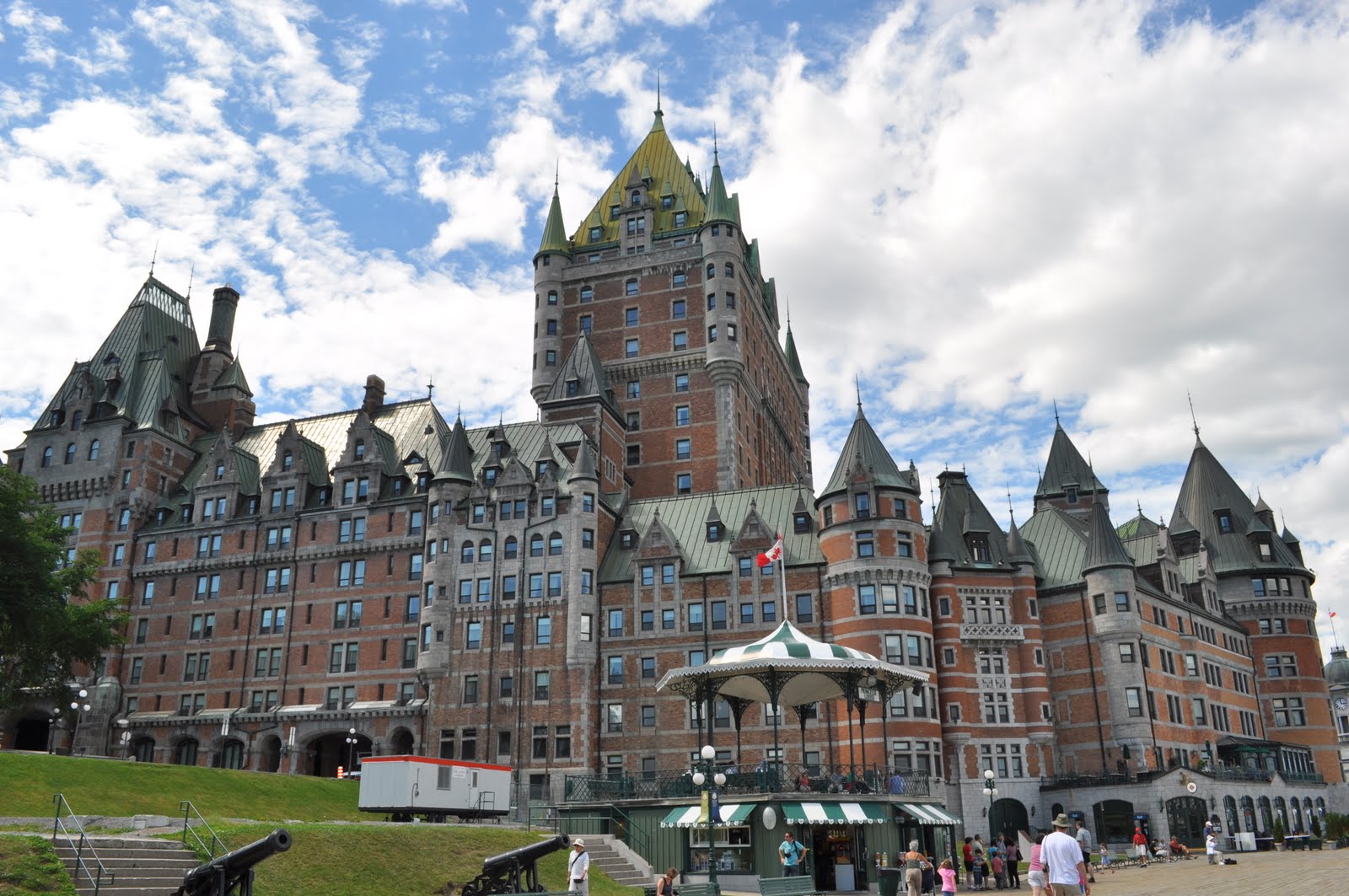
Wanted to get to Quebec to enjoy it since we had just one day there. Quebec is where Nouvelle France was founded in 1620 (the same year as the Mayflower landed at Plymouth Rock). We stayed at the Chateau Frontenac on the edge of the cliff overlooking the harbour. The hotel is one of the grande dames of hotels, built by the Canadian Pacific Railroad in 1893 to resemble a Loire Valley chateau. It is now run by the Fairmont. It was my mother's favorite hotel, so it is fitting that we are here on what would have been her 90th birthday.

Le Chateau Frontenac


Our room: Top floor, 3rd window from the left!


The streets of the only walled city in the western hemisphere north of Campeche, Mexico.


Baseball is everywhere! Try playing in on snowshoes with the Inuit! (photo of a museum photo)


Views from our hotel window......


Sunday, June 20, 2010

DAY 13: Montreal...The Day in Photos

Day 13 (no driving)

Our wake up call outside our window


Our Street, two blocks from the St. Lawrence River and one of the original streets dating back to the founding of the city in 1642.


The Basilica of Notre Dame


The Montreal Skyline


Phillip and Mimi


A little Romance


Liquid Lunch


Afternoon Thunderstorm


Our Wonderful Home away from Home